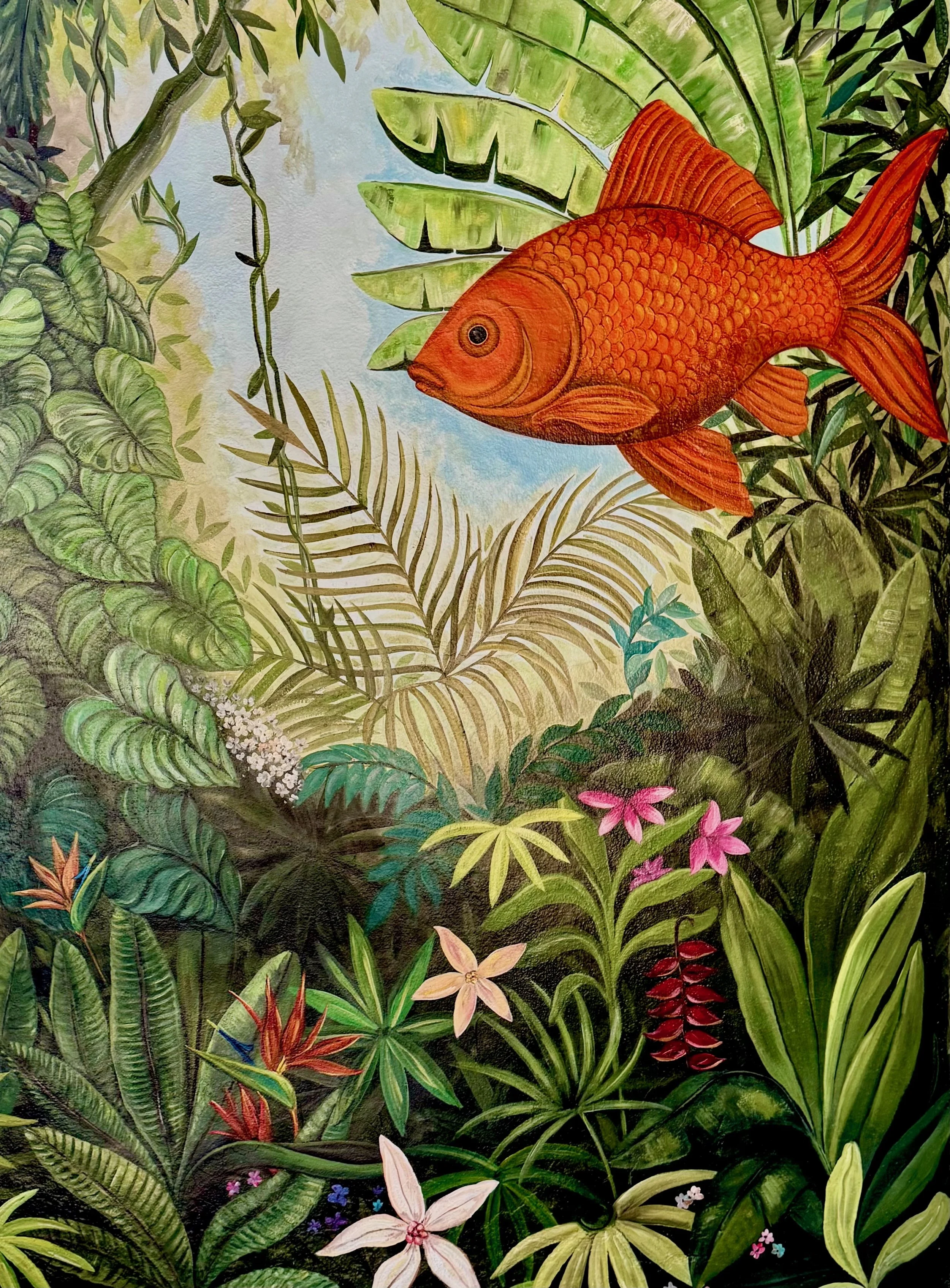
where goldfish fly
Sample pages
Chapter One
It was on the cusp of an English summer morning, that “Tiger” Lilly crouched down in the wet grass to retrieve a rare stray arrow, and found herself eye to gelatinous eye with a two-and-a-half-foot, fifty-odd-pound goldfish.
Since the day at age six when she’d decided to stop growing, Lilly had stayed just under four foot tall. Now, at ten, with a heaving wet überfish watching her from the bushes, she thought it might have been a hasty decision.
Never breaking eye contact, she slung back her hair, swung round her pink crossbow, and dropped to one knee. With one eye squeezed shut and the other peering through the crosshairs of her LittlePatriot™, she studied the creature carefully.
“What are you?” she said.
The fish – whose undulating girth almost equalled its rebellious length – said nothing. Squishy and wet, it side-eyed her as it body-scaped itself a bespoke spot in a pile of storm-soaked mown grass.
Lilly watched its orange-and-golden gills catch the fragile morning sun. The dew had left beads of magnification on the leviathan’s lipid scales, and she saw herself reflected in miniature a thousand times over.
She had no idea where the giant fish had come from, or if it was even supposed to exist, but the way it had wedged itself between the dandelions and the daisies told her it wasn’t going anywhere any time soon.
She decided to call it Hector.
“Hector.” She tried out the name, cautiously dropping her arms and softening her grip on the crossbow. Hector, after the multicoloured unicorn piñata her dad had strung up in the yard in his last-ever attempt at throwing her a birthday party.
It had been a year to the day since the accident, and “Tiger” Lilly had taken out her despair at her mother’s absence on the papier-mâché beast with fervour, if not surgical precision.
Standing here now, facing a freakishly oversized goldfish, she recalled the current of rage that had swept her up into a piñata-killing frenzy. She planned to tap back into that dark aquifer should Hector make any sudden moves.
Lilly sat down cautiously in the grass, her gaze never leaving Hector’s unblinking, saucer-sized eye. “You don’t scare me,” she said – but the vertiginous depths of his retina made her feel like she might tumble in and never be heard from again.
How on earth had an oversized fish made its way into their garden? The back gate was padlocked shut. Prickly blackthorn hedges surrounded the house. A solid redwood gate separated the balding patch of grass by the front door from the street beyond.
There was no easy way in – the only way was over something. She was just starting to enjoy herself, settling into what promised to be a Holmes-worthy conundrum, when the fish started to sing.
The sound wavered between the haunting lilt of a whale song and the indignant moan of a dog that’s been told to let the kitten go. It was otherworldly, hypnotic, beautiful even – but more than anything: it was very, very loud.
Lilly wanted Hector to stop drawing attention to himself. She pleaded (“Ahem. Would it be at all possible to stop singing?”), she shouted (“STOP! SINGIIIIING!”), she begged (“Please, pleeeeeezzze? Pretty please?”). She stomped her feet and tore at her hair – but the fish kept on singing.
Lilly didn’t want the neighbours to hear. This was her moment. She could be the new Betsy Bang: “Tiger” Lilly Daniels, girl scientist, champion of the unknown and unloved – master taxonomist, bringing much-needed order to chaos.
But first she had to hurry her Piscine Pavarotti to the coda of his aquatic aria. “What do you want?” she pleaded. Then she put two and two together. Slapped her forehead. Felt briefly silly, then rather chuffed. Fish. Water. The fish wanted – NO! – needed water.
She ran into the garage and started digging through the boxes and bags of junk lining the walls. At the bottom of a pile of faded beach towels – ESPAÑA OLÉ! – she found the kiddie pool her dad bought last summer.
It was a brash, fluorescent blue monstrosity, emblazoned with winking dolphins, tutu-ed octopuses, and jazz-handed starfish. Lilly had taken an instant dislike to it.
So the first time they’d set it up, it – conveniently – sprang a leak. But then her dad had dug out a small puncture repair kit, which admittedly was rather neat, and together they had fixed it.
At her father’s insistence, she’d stood in it arms folded, water around her ankles as it started filling. It had been a source of considerable embarrassment, but it would do for the task at hand: bring the fish to water.
Lilly zig-zagged out of the garage, the deflated heap of plastic towering over her as she tilted this way and that in a stubborn meander.
She spread the kiddie pool out on the grass, turned on its automatic air pump, and dropped in the garden hose. While it snaked around the bottom, another conundrum occurred to her – how to get Hector into the pool.
The fish was approximately three feet long. 91.44 centimetres. He had a girth of about two feet. 60.96 centimetres. Multiply girth by length squared and divide by 1,200: the formula for calculating the weight of a sunfish. That meant Hector weighed about 25.92 pounds. 11.76 kilograms.
Almost two stone of squirming, slimy mess with no straps or handles to hold on to. She was just about to formulate a plan involving pulleys and levers when she heard Hector’s song change from a wail to a hum. In a rare moment of inattention, she’d turned her back on him and now a low, haunting sound crept up behind her.
As the strange and beguiling song grew louder and closer, Lilly found herself precariously positioned between fish and water. She felt Hector loom up behind, with no apparent intention of going around her. Not wanting to be squished by a juggernaut with – apparently – places to be, Lilly scooted aside.
As she turned around, the goldfish sailed past her like a luxury liner, translucent against the rising sun. Its iridescent scales glowed red, orange and yellow, lighting up the tips of her eyelashes with bright flecks.
Like the sun flares in her mum’s old Polaroids.
Tiptoeing closer, Lilly found herself mesmerised by the sight of Hector the giant goldfish, floating weightless over her kiddie pool, hovering twelve inches of nothing but summer air above the glistening water.
Chapter Two
“Nice shorts!”
Vadim banged his head on the attic window and cursed under his breath. He stumbled down from the cowhide tabouret he’d climbed on to catch a glimpse of the hullabaloo in the garden. He was down to the dregs of his clean clothes drawer, and the pink silk boxers with the white leather sport stripes had been a matter of necessity rather than a fashion choice.
The octogenarian rubbed the angry bump forming on his head and blinked at the little girl standing in the doorway. He was unshaven, unkempt. Barefoot, with toenails that needed cutting. He ran his hands through his hair, trying to regain some decorum, but all that remained of his golden mane were a few strands of grey-blond straw.
“Why, thank you. Brigitte Bardot gave them to me.”
He stared at the unruly parade of socks and boxers drip-drying on the cross-rafters washing line. But what he saw was the bay of Saint-Tropez, shimmering gold in the evening sun. He smelled the centuries-old eucalyptus trees, heard the ice cubes tinkling in his glass. Felt the pastis burn his throat and warm his heart.
It was the seventies and Bé-Bé was everywhere.
“I think it was my name that made her a little nostalgic.” He turned back to Lilly.
“Do you want to come see my goldfish?” Big eyes stared up at him. No expression.
Vadim didn’t have kids of his own. Never wanted them. Until it was too late.
“Okay,” he mumbled. Might as well. It wasn’t like he had a big vernissage to go to. Or a hip New York club to run.
Vadim watched Lilly take his wrinkly hand and lead him down the stairs. What happened, old man? He’d been a World War II flying ace once, a celebrated artist later, a hip discotheque owner somewhere in between. He’d been a man.
He’d been handsome, too. Strapping, some said. He would light up the room and draw people in. Women he didn’t know would talk to him as if they’d already slept together, swirling around him with an ease that said, just say the word.
And look at him now: skin hanging off bones – apart from a flabby spare tyre that cut off his downward event horizon. Old-man nipples and wrinkles down to his ankles. Shuffling along behind a ten-year-old kid to go and look at a goldfish.
He pulled his red towelling robe tighter around his faded AC/DC T-shirt. Lilly’s tiny hand clasped his bony fingers as she led him outside.
“This better be worth it,” he grunted, expecting to see a small fishbowl, murky water, and a titchy fingerling.
But at the end of the suburban back garden he came face to face with what appeared to be a giant goldfish. Humming a cha-cha and doing a body wave in the kiddie pool.
He stopped. Rubbed his eyes. Looked again.
It was still there.
“It’s a goldfish.” Lilly opened the tome clamped under her arm.
He turned and stared at her. Jaw dangling.
“Carassius auratus,” she continued.
He looked at the book. The LittleScientist Encyclopaedia.
“Of the carp family. Cyprinidae. It has all the right characteristics.”
He looked at the fish. Looked back at Lilly.
“Except for the size. I can’t find any mention of a giant subspecies.”
Once, as a kid, he’d won a goldfish – a fairground prize that went belly-up before breakfast. That single tragic flop was the extent of his expertise. He’d certainly never heard of any giant subspecies. But he was fairly sure they weren’t supposed to fly.
He walked around the thing, stopping and stooping to pass his hand underneath. The fish wasn’t in the pool – it was hovering a foot above it. He was starting to worry. Thinking sudden-onset dementia. Thinking no more morning medication.
Lilly stood motionless by the edge. Ten years old. Total composure.
He said, “Where did it come from?”
She shrugged. “I can’t get it to sit down.”
The fish snorted. Bucked like a young mustang at a rodeo. As if to say, exactly. No sitting down.
Vadim eyed its squamous hide. “It looks dehydrated.” He inched closer and reached out a tentative hand.
“Don’t touch it!” shouted Lilly. “You’ll damage his protective slime coat. Change his microbiome. He could get ill.”
“He?”
“I call him Hector.”
“OK.” Don’t name the lost puppy.
“Do you think it’s a boy?” asked Lilly.
“I think it’s dried out. Disoriented.”
Like it had been on a bender, he thought.
Like it had partied all night and ended up at six in the morning in the Polo Bar, dancing on tables, shouting, drinks on me!
Not that Vadim did that kind of thing. Much.
“Where’s your hose?” A brisk squirt of ice-cold water used to work on him. Why not on the fish?
Lilly handed Vadim the garden hose and ran to turn on the tap.
“Ready?”
“Go for it.”
But as soon as the beam of water hit, the fish lunged at him, its mouth a dark, infernal rift that blotted out the sky.
Vadim jumped back and let go of the hose. Hector settled back into a self-indulgent melancholy murmur.
“He doesn’t like it,” said Lilly.
“Quite.” He dusted himself off.
Vadim had seen many a dehydrated near-corpse before. When he was the New York Discotheque King, he used to sweep them out onto the pavement every morning. He said:
“We have to get Bubbles here wet muy pronto.”
Or find a toilet big enough for a dignified send-off.
Chapter Three
The afternoon sun shimmered through the treetops and dropped columns of gold dust into the garden of Camden Community House. Beyond the peeling white walls the city hummed and distant sirens wailed, but under the nurturing arms of the birches the day was going along its languid, summery way.
“What Sartre said was that the waiter was not being authentic.” Jake squinted at the flashes of sunlight filtering through the leaves and felt a familiar faintness come over him. Not now, he thought – not here.
He took a deep breath and turned his attention back to his class. His pupils, all two-and-a-half of them, sat on tree stump chairs on the grass and stared at him expectantly.
“What he meant was that the man was playing at being a waiter – hiding behind the role, acting out a part in the way people expected.” Sometimes Jake felt that he was playing at being human. Playing at not being numb inside.
“Aren’t we all doing that, in a way? Performing, for the sake of others?” Stan, a thirty-five-year-old train driver, looking for life’s Big Answers in Jake’s adult education class. He’d seemed dejected when Jake told him, philosophy is about learning to live with the questions.
“To an extent, sure. Most modern philosophers would say the self is formed intersubjectively.”
Three wide-eyed stares. Waiting for Jake to explain. Or maybe just trying hard not to fall asleep.
“The idea is that we shape each other. Between us, we draw the lines that constrain who we are – and who we allow each other to be.”
A tentative nod. The rustle of a notebook.
“You mean we limit each other?” Raïka, a twenty-three-year-old history postgraduate, studying the rise and fall of the great civilisations. Trying to offset ten thousand years of hubris and bloodshed with some quiet contemplation. As if the Great Thinkers all got along so swimmingly.
“Maybe delineate is a better word. We don’t just limit each other, we also create possibilities for one another. Constraints and affordances.” Jake glanced at Raïka. “Every road we take makes it easier for others to follow. Every door we shut says, don’t go there. Whether good or bad, we make each other into what we are.”
“My mum says that when they made me, they broke the mould,” said Anil, the eleven-year-old son of Mary P – head of the adult education programme and Jake’s boss. Anil had been Lilly’s one-friend-exactly since first grade.
During the summer, every day was bring-your-child-to-work day – but Anil was only ever half there, hence the decimal on the attendance list: the other half was coaxing a ladybird onto his outstretched finger.
Jake felt his phone buzz in his pocket. Lilly. He held up a give-me-a-minute finger and walked deeper into the garden.
“Lilly, honey, are you okay?” He didn’t like to leave her at home with Vadim, but with school out, and no money for a sitter—
“Father. I’m fine. Where do we keep the sprinkler?”
Father.
Jake remembered her heartbeat, warm and fast against his neck, her tiny body flopped on top of him after their bike ride. Little five-year-old Lilly, whispering, I’m so tired, daddy.
“You mean the thingy that connects to the hose?”
Lilly was always entangled in something. Some crazy invention, some wild adventure. Lately, her escapades included Vadim. And excluded Jake.
“Yes, Father. The sprinkler.”
Oh, Lilly. I’m still hurting too.
He couldn’t tell her, of course. Not without bringing everything back up. Jake wondered why she needed the sprinkler. He hoped she hadn’t set anything on fire. Again.
“It’s in the garage, on the rack.”
The cold finger of fear crept up his spine, one vertebra at a time. Lilly liked to invent her own science experiments. They did not always end well.
“Are you sure everything is okay, Lilly?”
“Yes, thank you. It’s for Hector. He’s drying out.”
“What? Lilly—” He was in full panic mode now. Who the hell was Hector?
“Goodbye, Father.”
Click.
The phone lay in his hand, small and mute and indifferent. He had to get home. Find out what was going on. Jake walked back towards the group.
“But if Clark Kent is married to Lois, and they work together, and live together…” argued Anil.
“Then that’s his person,” added Raïka, taking Anil’s side against Stan, who seemed bemused by their pleas.
“Right?” said Anil. “And if that’s his person, then surely it’s when he dresses up as Superman that he’s not being authentic.”
Jake stepped in. “Not necessarily. The self is, in many ways, a construct. A simplified facet of ourselves that we show to others. A role, if you like.”
Like the philosopher who can fix the world – but not himself.
Stan nodded. “So isn’t Clark Kent the role he plays, to hide the fact that, in reality, he is Superman? I mean, the glasses are ridiculously ineffective – but they’re meant as a disguise, right?”
Jake shrugged. “The self we project at any given time is fluid. We adapt to the people around us, to the situation we’re in. We’re all multi-faceted. We can be Clark Kent and Superman.”
He thought about it for a moment.
“The mistake is letting others write our parts for us.”
“To eat with someone else's mouth,” said Raïka – tentatively, looking down.
Jake caught her eye and smiled at her.
“To sleep with someone else’s eyes, to move according to someone else's whim.”
Stan stopped writing and looked up from his notepad. Anil held up his finger and watched the ladybird fly off.
“Veronica Franco,” said Raïka. “A Venetian poet and courtesan, during the Renaissance.”
Anil looked up at Jake. “So Clark Kent doesn’t have to be a fraud – as long as he writes the script himself.”
Smart kid. No wonder Lilly liked him. She didn’t suffer fools gladly. Or at all.
“That’s what Sartre was getting at, I think – the waiter could have done his job in a way that felt true to himself. But instead he played the role of the archetypal waiter. He was acting in bad faith.”
Jake wondered if he would ever feel like himself again. The self he was with Amanda, the self she allowed him to be. He started packing his worn-out satchel.
“Look, don’t worry if it doesn’t all make sense straight away. Sartre’s waiter is considered one of the worst examples in philosophy.”
He caught their baffled looks and smiled. “The main point is, what we choose to do makes us who we are – not the other way around.”
Nicely put.
We can be Clark Kent and Superman.
So how come he felt like little Jimmy Olsen?
Chapter Four
He’ll freak out and call the police or the RSPCA, blah blah blah.
She knew Vadim was right, of course.
They’ll take Hector away, and poke and prod him in a lab, blah blah blah.
That didn’t mean she had to like it.
Before you tell your dad, let him sit down and have a drink, blah blah blah.
Well, how long was that going to take?
“Vadim is cooking. Ragù alla Bolognese.”
Lilly stood on a chair next to the cooker, wearing her best nurse’s uniform. She showed her father the silver instrument tray.
“It’s a delicate surgical procedure.”
Jake went, oh, soundlessly. He lingered in the kitchen doorway, framed by the red sun setting over the back garden.
Did he suspect anything?
“Scalpel,” barked Vadim, palm up.
“Scalpel,” repeated Lilly, handing him a wooden spoon off the tray.
“Onions,” said Vadim.
“Onions,” said Lilly, snapping on her mum’s old pink diving mask before carefully passing him a cup of chopped onions.
“Spaghetti!” said Jake.
“It’s Ragù alla Bolognese,” insisted Lilly.
Honestly.
She was dying to tell her dad about Hector. He’d have to take her to Stockholm when she won the Nobel Prize. Which she would, as there was no mention of a giant flying goldfish in the LittleScientist™ Encyclopaedia.
Vadim barked some more, pointed at the tray. Lilly handed him the garlic, then the herbes de Provence. She recognised the sweet, sharp smell and took a deep breath. This was an operation for world-class specialists. Flown in with Red Cross helicopters.
“I got the recipe from Dalida,” said Vadim. “It was in the early seventies, and La Italiana had taken France by storm.”
Lilly handed him a bowl of passata. He poured in the thick tomato mush and turned around to face Jake.
“She cooked for me in my atelier.”
Irrelevant, thought Lilly.
Three times, hard.
No reaction.
“Afterwards we walked along the Seine. She told me, Gigi, if we fall in love we will destroy each other. If I hadn’t left for New York, who knows…”
He stopped stirring, stared into the distance.
Lilly tried again.
Irrelevant, Irrelevant, Irrelevant.
Nada.
“Yes, who knows,” mumbled Jake, reaching for the crisped-up bacon bits.
“FATHER!” shouted Lilly, yanking the tray away. “It’s been sterilised.”
Vadim had told her not to tell her dad about Hector until after dinner. She didn’t want any more unnecessary delays because of procedural mistakes.
“So Jake,” said Vadim, tossing the bacon into the sauce, “how was your class?”
He turned around and ran his hand through his leftover strands of hair. “Any closer to unravelling the world’s great mysteries yet?” He winked.
Lilly’s dad said nothing.
“Scissors,” barked Vadim, still smiling, still looking Jake in the eye.
“Scissors,” said Lilly, handing Vadim the cheese grater and the Comté.
He turned back and started grating.
“It’s French cheese,” said Lilly. “Like Mum used to buy.”
Vadim stirred the sauce. Added some wine. Poked the pasta.
Jake checked his shoes. Picked some lint off his shirt.
“That’s nice,” he said finally.
O.M.G., thought Lilly. Grown-ups. You can’t talk to them about anything without them getting weird about it.
“Sooo,” said her dad, “anything interesting happen here today?” He walked over to the window and watched the sunset paint the clouds violet and pink.
Lilly and Vadim exchanged a look. Jake had parked his car in the garage and come in round the back. Had he seen the fish?
“Who’s this Hector Lilly was talking about?”
Uh-oh, thought Lilly. Maybe Vadim was right.
Maybe he would freak out.
“O-KAY!” said Vadim, his usual baritone croak leapfrogging into a squeak. “Dinner’s ready.” He strained the spaghetti and put the pot on the antique wooden table.
A hot pot and no trivet, on the table her mum and dad had found in a little brocante shop in France. Lilly gasped – her dad would go ballistic. Never mind the fish in the garden.
“So, what have you guys been doing?” said Jake. “The two of you. Together.” He pulled out a moustache chair and sat down. “Any new projects you want to tell me about?”
He was fishing.
Which was ironic, considering.
“Tell me what you think of this wine, Jake,” said Vadim, pouring the dark red liquid into a bulbous glass and holding it up to the light. “I got it from Sting. He sent me a crate last year.”
Jake picked up the bottle, turned it around. Studied the label.
“From his own vineyard in Tuscany,” said Vadim. “I guess he’s still grateful that I told him and his boys to bleach their hair, back when they started.”
“It says Sainsbury’s on here,” said Jake.
“Well, you know what he’s like. Modest.”
“O-KAY!” said Jake, leaning forward to look Vadim in the eye. “I know two things. One, Sting is not modest – why should he be. Two, something’s going on and everyone’s acting extremely suspicious.”
Lilly could feel her cheeks burning. The little acrobat in her mind was doing somersaults. The clock on the oven was getting louder.
Tick. Tock. Tick. Tock.
“Jake. Everything’s fine.” Vadim poured more wine into Jake’s glass. Jake waved it away.
“There’s been…” Vadim looked down and rubbed his grey stubble.
Come. ON.
“…a development.”
Lilly felt like she might combust. The little acrobat was on the rings, going faster and faster, turning into a blur.
Tick-tock-tick-tock.
The clock made her ears hurt. Her heart was beating louder and—
“I FOUND A FLYING FISH!” she blurted.
Chapter Five
“Hector is a fish?”
Jake stared at the two of them, side by side at the kitchen table. Vadim in the red towelling robe he swung round like a superhero cape. Lilly in a nurse’s costume that was getting a tad too small. Nodding like they were at the Headbangers Ball.
“I call him Hector,” said Lilly.
Jake looked at the tumbler in his hand. She named it. The giant fish. He tipped back his head and took a long swig from the bottle of Jack in his other hand. Don’t name the lost puppy.
“And it flies?”
Off they went again, bobbing like LSD-fuelled nodding dogs – Catweazle and Lucy Van Pelt, in perfect unison. Psilocybin, thought Jake. Shrooms. There’d been mushrooms in the bolognese.
Surely not the magic kind?
“He sings, too!” said Lilly.
“And dances,” added Vadim. Helpful.
Jake took a deep breath. Lilly was too caught up in her imagination as it was – she didn’t need an eighty-something confabulator to encourage her. But before he could point out the improbability of a giant flying goldfish, an unearthly lament drifted in from outside.
“He’s getting restless again,” said Lilly. “We don’t know what he wants.”
Jake looked out at the pitch-black garden. There was something out there. And it sounded like the love child of a whale and a seagull. He lifted the Old No.7 and chugged. They were going to need another bottle. Crate, maybe.
“Why didn’t you call the RSPCA?”
Lilly and Vadim burst into overlapping anaerobic rants about Betsy Bang and scientific plagiarism (Lilly) and the fish being stuck full of electrodes (Vadim), followed by elaborate gesticulations indicating how high, how long, how wide (both), some frightening throat singing (Lilly), and some surprisingly nimble dance moves (Vadim).
“Okay,” said Jake, hands up in surrender. “What about the local police?”
“The cops?” said Vadim, scowling like he’d smelled a Stinking-Bishop-and-jackfruit canapé. “You can’t trust them, man.”
He leant back, ready to launch into one of his epic stories. “I was hanging with Mick and the lads when Keith got done for—”
“I want to see it,” said Jake.
Vadim glared at him, looking none too happy at being deprived of his moment. Tant pis. Jake was getting tired of being on the outside of Vadim and Lilly’s little Dream Team.
Lilly started digging through a sports bag, and came back up brandishing a yellow miner’s helmet with a giant headlamp. She fitted it on her head – TA-DA! The plastic buttons on her nurse’s uniform hung on for dear life.
“Be prepared!” She modelled the helmet from both sides. “A good girl scout is never caught out.”
“Be prepared,” agreed Vadim, tying up his housecoat and grabbing a heavy black torch.
“Let’s go,” grumbled Jake, as they marched single file through the kitchen door and into the garden.
Outside, the last streaks of sunlight had given way to a sultry summer night. As they edged forward – Lilly lighting the way, Vadim close behind – Jake could almost hear Joni singing Night Ride Home.
He remembered another night like this, in another life, driving with the windows down over French country roads. The crickets in the wheat fields keeping time, Amanda singing along.
I love the man beside me.
We love the open road.
“Wait!” Lilly crouched down, one arm out to hold them back. Vadim passed Jake a rubber torch. He tried it. Nothing. The moon was skulking behind a thick blanket of cotton wool, leaving only a cone of grass lit by Lilly’s helmet.
Then he heard it: a low, intermittent warble, like a wounded sea lion.
“Is that it?”
“Shh!” Lilly crept forward, holding up an emphatic stop-talking finger. Step. Pause. Step. Pause. The warble turned into a low, oscillating gurgle. Her headlamp’s beam probed the darkness, flashing now and then on something orange and slimy—
Until it locked onto a huge bottomless eye.
The gurgle fell silent. Jake stopped breathing. A primordial roar tore through the stillness of the night – and the headlamp went flying. Jake and Vadim leapt aside as Lilly was spat out on a torrent of slime, landing between them with a mighty squelch.
“LILLY!” Amanda will be so upset, thought Jake, before realising, no, she’s not – not ever again. “Are you hurt?”
Lilly sat up in the puddle of mucus, wiping viscous drops of fish gunk off her sleeves.
“He doesn’t like the spotlight.” Each word formed a tiny bubble in the shiny layer of gloop on her face. “I need to put that in my report.”
She spat out a few gooey scales and wiped the ooze off her cheeks. Two doors down, a window opened.
“Keep it down, out there!”
“Yes, Mrs Hickinbottom. Sorry.”
The window shut with a grumble.
“Come on, soldier. Time to regroup.” Jake helped Lilly up from the cooling puddle of slime. But as they tiptoed back towards the house, the fish started to sing.
They froze, three wide-eyed statues in a surreal version of What’s the Time, Mister Wolf.
At first, the low, guttural hum sounded eerily similar to the theme from Jaws. Ta-dam. Ta-dam. Ta-dam.
They were about to bolt when it turned into Can’t Take My Eyes Off You. Ta-dam, ta-dam, ta-da-da-ta.
Great, thought Jake. We’re about to be gobbled up by an aquatic Engelbert Humperdinck.
“Look,” said Lilly, pointing at their shadows, long and insectile in a sudden pool of light.
Turning towards its source, Jake saw a giant luminescent goldfish, floating in the languorous summer air, casting its golden light over the shimmering water, the baby-blue pool, the washed-out lawn – and the three of them, standing there staring.
He shielded his eyes with a trembling hand.
“Hello, Hector.”
Chapter Six
¡María Inmaculada Concepción!
You can’t keep doing this. Slumming around this island, pretending you’re here because there’s so much wildlife or it’s fascinating how the marshes and the sea interact.
Escucha a tu mamá, María. Put on your big girl pants and haul your pompis over to Santa Barbara. Finish your PhD. Sigue tus sueños, if you have any dreams left to follow.
“I should go back,” you say to Buddy, the car mechanic slash amateur night fisher from Athens, Georgia. “Get my doctorate.”
Instead, you reach for the joint he’s holding out to you. You take a long, lazy toke, pinched fingers to pout, there’s just a stub left.
When the ember bites your lip, you toss it over the side, sparks flying. It disappears, swallowed by the waves rolling underneath the wooden pier.
“See that one?” says Chad, pointing up at a bright star that flickers yellow, red, blue and pink. “That’s Sirius.”
Chad is Buddy’s shoe-salesman friend. The two of them come down from inland Georgia every year to fish and drink beer.
“It twinkles ‘cause of the Earth’s atmospheric gases.” He unzips a gym bag and pulls out a thick red net. “Y’all ready to catch some giant bull redfish?”
“It’s the Dog Star,” you point out – not that you don’t enjoy a little mansplaining, now and then. “Part of Canis Major. The Big Dog.”
Sirius. Your dad’s favourite. So bright it paints a narrow band of white across the water. Like a mini-moon parting the ocean.
The sky is so pregnant with stars it looks visceral. In L.A., you get faint little pinpricks at best. Here they protrude out of the deepest blue, all white and swollen.
“Why did you leave?” asks Buddy, shining his flashlight on the water, searching for his big prize. “You decide you didn’t wanna be a marine biologist?”
You don’t want to stay and watch, María. Not while they’re lifting some poor redfish out of the water with their big macho net.
“You don’t have to go back,” says his stargazing sidekick. “You could get a job at SeaWorld, easy.”
Swell. Your life’s ambition, according to Chad. Making orcas jump through hoops.
“I had a massive burnout,” you tell Buddy. “My mum worked two jobs to put me through university.”
You rub the envelope in your pocket, feel its reassuring heft. Enough cash to get you back to California.
“So when I started my PhD, I wanted to rush through it, start paying her back.” Yet here you are, taking more of her money.
¡Qué vergüenza, María! Shame on you.
“Fuck me. That’s a red,” shouts Buddy.
“Yeah, it is,” shrieks Chad. “A big one, too.”
“Drop the net,” shouts Buddy. Dancing around in a frenzy.
They’re not rednecks, María. They’re not white trash. They’re just regular estadounidenses. Everything is theirs for the taking. God-given.
You get up from the bench, ready to leave. You don’t want to see them go all giddy over their heroic catch while a beautiful, defenceless creature thrashes on the pier.
“So I said to myself,” you try, a bit louder, “what the hell am I doing?”
They’re not listening. Too busy manoeuvring the net around as they lure in the poor redfish.
“Specialising in marine conservation,” you shout, “when the oceans are dying, and nobody gives a shit.”
Nothing. Just hoots and hollers. You shrug, and walk along the wooden gangway, back to shore.
When we’re fishing species to near-extinction ‘cause we think plant-based is some kind of lefty plot.
“See you, MC,” they shout, the sound swallowed up by the waves passing under your bare feet. Not likely, you think.
You remember the documentary that got you into this mess, a two-part special on microplastics. Watching the fish wash up with stomachs full of plastic, you thought: resistance is futile.
You felt so disheartened, you got yourself a job at the North Carolina Aquarium, all the way over on the east coast.
When we run, we run fast and hard. And blind.
You walk up Tybrisa Street, pop into Wet Willy’s. A John Mayer track is blaring from the Tannoys.
“Hola, Mateo,” you shout. “Fix me a frozen daiquiri to go?”
He shouts back, I got you, MC. You watch him mix your drink.
“You might not see me for a while. I’m thinking of going back.”
He tells you, follow your dreams, guapa.
Great. Another one.
You take your go cup and walk out, while Mayer starts a new track. Gravity is working against me. Tell me about it, college boy.
You suck the cool, sweet liquid through the straw as you walk to your home away from home: The Captain’s Choice Motel. Lost souls only, no family holidays here.
Not what you imagined, when you were making your way across the USA. Stopping along Route 66, spending too much money in tacky gift shops, buying a dreamcatcher, key rings, a fridge magnet. Thinking, there’s a paycheque coming my way.
But when you got to Roanoke Island, you found the job had gone to a local kid with a gold crucifix and a Confederate-flag T-shirt. And as you drove off, blinded by the setting sun, the pastel-coloured houses with their perfect lawns sneered at you: ain’t nothing for you here, chica.
So you hit the 95 and headed south, thinking, get out. Run. Run like the folk singer on the radio, getting away from her unfaithful lover: Out here in Savannah, it’s pouring rain. Palm trees in the porch light like slick black cellophane.
Savannah. Four hundred and fifty miles south. Palm trees sounded good. So you fell in behind a convoy of Mack trucks and let them lead the way. Their rigs looking like elephants dolled up for a circus parade, with hundreds of little lights that made them seem festive and sad at once.
And you, trailing them in your beat-up old Volvo, like the ugly duckling nobody wanted.
It’s midnight when you turn the key in your motel room door and your phone rings. Nine pm out on the west coast. You push the button.
“You got the money?” No hello, no how are you.
“Hola, mamá. ¿Qué tal?” You know what’s coming.
“I was saving it to visit your uncle in Bogotá.” Of course. In Hispanic families, money comes with a side helping of guilt. Must be a Catholic thing.
Don’t bite, María. Let your mother talk. She tells you, get on a plane, leave that old car, come get your degree. Here it comes: five, four, three—
“Sigue tus sueños, María. You have to dream for the both of us.”
You remember another phone call, a while back, the night the Roanoke job fell through. You rang her from a gas station forecourt, after taking a nap in your car. Told her you’d head back tomorrow, maybe the day after.
Instead, you latched on to another neon pachyderm parade and watched your hood eat the white lines heading south. You got to Savannah as the sun was coming up, drove straight through to Tybee Island. Told yourself, it’s just for a couple of days, chill out, get back on that horse. That was two months ago.
Brava, María. Way to follow your dreams.
You realise your mum is still talking, her voice tinny and far away. You’re half listening, half scrolling through job vacancies on your laptop.
You’re just about to slam it shut when you hear the chime of a new email. There’s a message from someone calling themselves betsybang6:
Please help! What do you feed a giant, bioluminescent flying goldfish?
You think, someone’s been power-popping the happy pills. Then you scroll down – and gasp.
There’s a picture.